How We Clean Carpet in Spartanburg, SC — The Full Process, Nothing Hidden
Seven steps. Real chemistry names. Real equipment specs. And the reasons why each one matters specifically for Upstate South Carolina homes — because what works in a dry climate doesn’t automatically work here.
Why the Carpet Cleaning Process Matters More Than Most People Realise
Most homeowners evaluate carpet cleaners on two things: price and availability. The process — the actual sequence of steps, the chemistry, the equipment — gets treated as background detail that all professional companies handle roughly the same way. They don’t.
The difference between a carpet cleaning job that leaves your floors looking genuinely clean and one that re-soils in three weeks, or worse, leaves residual moisture that becomes a mold problem in Spartanburg’s summer humidity — that difference is almost entirely in the process.
What separates a professional carpet cleaning process from a rental machine result?
Three things: water temperature and pressure, extraction rate, and drying management. A rental machine operates at 60 to 80 PSI with water warm but not hot enough to break soil bonds. Our truck-mounted system operates at 300+ PSI and 180°F. A rental leaves 30–40% of moisture in the carpet pad — in Spartanburg summers at 55–65% humidity, that’s how mold starts within 24 hours. Our extraction rate is 95%+, and we set air movers in every room before we leave.
The process on this page is what we use on every residential and commercial job in Spartanburg County. Not an approximation. Every job.
| Spec | Our Process | Rental Machine |
|---|---|---|
| Water Pressure | 300+ PSI | 60–80 PSI |
| Water Temperature | 180°F | 100–120°F |
| Extraction Rate | 95%+ | 60–70% |
| Pre-Vacuuming | ✓ Every job | ✕ Not included |
| CRB Agitation | ✓ Included | ✕ Not included |
| Air Movers | ✓ Every room | ✕ Not included |
| Dry Time (summer) | 4–8 hours | 12–24+ hours |
BEFORE WE BEGIN
Before Any Equipment Comes Off the Truck — The Walk-Through
What happens at the beginning of a professional carpet cleaning appointment?
🔍
Fiber Identification
The carpet fiber type determines pre-treatment chemistry, CRB agitation pressure, and water temperature. Nylon, polyester, Berber, and wool each require a different approach. This is why the walkthrough comes first.
🗺️
Stain Mapping
We identify every stain by type — red clay/iron oxide, tannin, protein, pet urine, dye transfer, filtration soil. Each type responds to different chemistry. Knowing what you’re treating before you treat it is what separates accurate pre-spotting from guesswork.
🔦
UV Blacklight Scan
On every pet household job, we scan with UV blacklight to map urine deposits. The visible stain is almost always smaller than the actual contamination area. We map the full extent before we start — and we tell you what we found honestly.
💬
Honest Expectation-Setting
Before any equipment comes off the truck, you know what we expect to achieve on each room and each stain — including what can’t be fixed. Bleach spots, permanently set iron oxide, fiber damage: you know before we start, not after you’ve paid.
THE FULL PROCESS
The 7-Step Carpet Cleaning Process We Use on Every Spartanburg Job
HEPA Pre-Vacuuming
Why do professional carpet cleaners vacuum before cleaning?About 80% of what’s in your carpet is dry, insoluble soil — clay dust, pet dander, pollen, hair, lint. These particles can’t be extracted by a hot water system working on them in suspension. Getting them out before any moisture is introduced is the foundation of everything that follows.
If you skip pre-vacuuming and go straight to wet cleaning, you’re mixing dry soil with water and working it deeper into the fiber. You’re making mud. Companies that skip this step do it to save 20 minutes per room. We don’t skip it.
HEPA filtration is specifically important in Spartanburg during March–May pollen season — birch, cedar, and maple pollen embeds in carpet pile and standard vacuums recirculate fine particles. HEPA captures them.
Commercial HEPA upright · Every room · Full passesPre-Treatment Application
What does carpet pre-treatment do and why does it matter?Pre-treatment is the chemistry step that does the heavy lifting before extraction. A water-based, eco-friendly pre-spray applied across the full carpet surface breaks the bond between soil particles and carpet fiber — suspending them in solution so extraction can pull them out.
We use different chemistry for different soil types: Traffic Lane cleaner on mineral-heavy corridors; Peroxy-based enzyme solution on pet-affected areas (breaks down uric acid crystals at the molecular level — not a masking agent); rust/iron oxide pre-treatment on red clay stains specific to Spartanburg County’s Piedmont soil.
After application, we allow 5–10 minutes dwell time. Rushing this step reduces effectiveness significantly.
5–10 min dwell · 3 chemistry types · Spartanburg red clay protocolStain Pre-Spotting
How do professional carpet cleaners treat specific stains before extraction?Pre-spotting is the targeted treatment of individual stains before the main extraction pass. Different stain types require entirely different chemistry — using the wrong spotter can set a stain permanently.
Tannin stains (coffee, tea, wine) — acidic spotter, blotted inward from the perimeter. Protein stains (blood, food) — enzyme-based spotter at ambient temperature; never hot water on protein. Red clay — rust-specific chemistry with careful management of the stain boundary. Unknown stains — spot-tested on an inconspicuous area first.
This step is where the honest walkthrough pays off. We already know what chemistry each stain needs. We’re not experimenting.
Stain-specific chemistry · No guesswork · Perimeter-in blottingCounter-Rotating Brush (CRB) Agitation
What is a CRB machine and why do professional carpet cleaners use it?A counter-rotating brush (CRB) uses two cylindrical brushes rotating in opposite directions to work pre-treatment down through the full depth of the carpet pile — from the face fiber to the primary backing. This mechanical agitation loosens soil bonds that surfactant chemistry alone can’t break.
This is what separates professional-grade cleaning from rental machine results. A hot water wand cleans the top 30–40% of the carpet pile. The CRB reaches all of it — especially the base-of-fiber soil that’s been compressing down for months or years under foot traffic.
In Spartanburg County homes specifically: red clay soil compresses into the fiber base under foot traffic. Surface extraction without deep CRB agitation leaves significant iron oxide behind. This step is why our red clay results look the way they do.
Full pile depth · Iron oxide specific · Not used on delicate fibersHot Water Extraction at 180°F
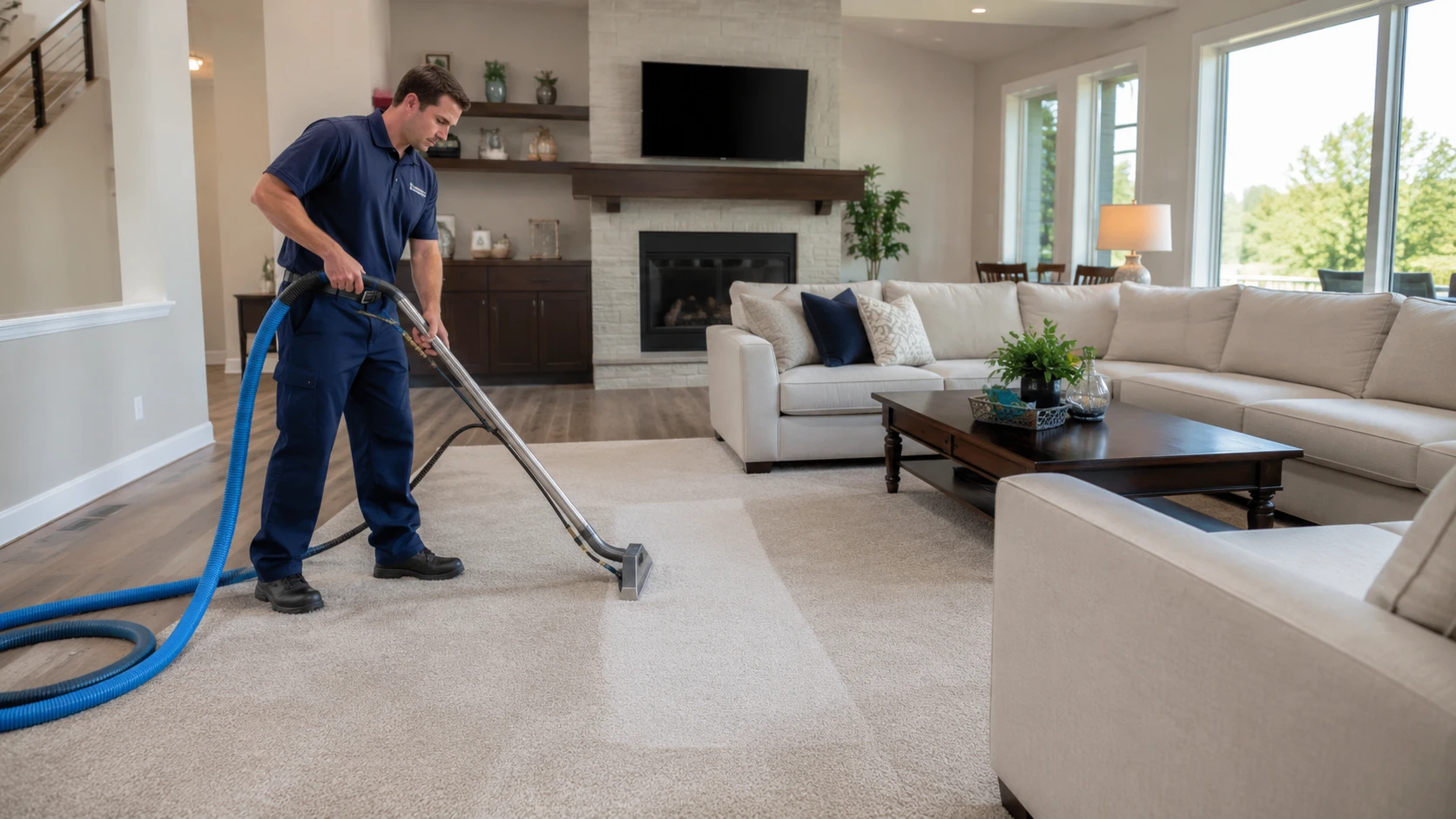
How does hot water extraction carpet cleaning work?Our truck-mounted hot water extraction unit maintains water temperature at 180°F and operating pressure at 300+ PSI. The unit sits in our vehicle and connects via hoses — this is what separates truck-mounted from portable units. The power of a truck engine drives the pump and heating system, producing substantially higher pressure and temperature than any portable unit can achieve.
A dual-jet cleaning wand injects 180°F water through the carpet fiber at 300+ PSI while simultaneously vacuuming the solution back out — extracting both water and dissolved soil in a single pass. Extraction rate: 95%+. Portable units achieve 60–70%. Rental machines similar or less.
The temperature difference matters beyond cleaning: 180°F water kills dust mite larvae and denatures the proteins in pet dander, contributing to allergen reduction that cooler water simply doesn’t achieve. This is why professional hot water extraction produces measurable allergy improvement in Spartanburg households where vacuuming alone hasn’t.
300+ PSI · 180°F · 95%+ extraction · Truck-mountedPost-Spotting & Inspection Pass
What happens after the main carpet cleaning extraction?After the full extraction pass, we walk every room and assess. Most stains — general soiling, light tannins, surface pet staining — are gone or significantly reduced. The ones that aren’t get individual post-spotting with more concentrated chemistry followed by a rinse extraction pass.
We also assess for wicking at this stage — when residual contamination in the pad migrates back up through the fiber as it dries. If we see early wicking signs before we leave, we address it on the spot rather than waiting for a callback.
When a stain we flagged as potentially permanent doesn’t respond to post-spotting, we’ve already had that conversation. When something comes out better than predicted, we tell you that too.
Room-by-room walk · Wicking assessment · Targeted re-treatmentSpeed Drying with Air Movers
How long should carpet take to dry after professional cleaning?With 95%+ extraction and air movers running, most Spartanburg homes dry in 4 to 6 hours under normal conditions. In peak summer months — June through August, when humidity sits at 55–65% — allow 6 to 8 hours.
Air movers are not optional equipment we offer as an add-on. We set them up in every carpeted room we clean, before we leave, on every job. Here’s why this matters in Spartanburg specifically: passive drying from June through September is slow and unreliable. Extended damp time in a warm SC summer creates conditions where mold spores begin colonising the carpet backing.
Air movers create high-velocity airflow that accelerates evaporation. We position them for full room coverage, adjust for furniture, and tell you exactly how long to leave them running.
Every room · Every job · 4–8 hr dry · Mold risk eliminatedSPARTANBURG-SPECIFIC
How Our Process Adapts for Spartanburg County Conditions
Why is the carpet cleaning process different in Spartanburg, SC than in other parts of the country?
🏗️ Upstate SC Red Clay Soil (Iron Oxide)
Spartanburg County’s Piedmont geology produces iron-oxide-rich red clay throughout the county. This soil bonds to carpet fibers differently than organic or sandy soils — it requires rust-specific pre-treatment chemistry (not standard pre-spray), dedicated CRB agitation to break the iron oxide bond at fiber depth, and careful management of the stain boundary to prevent lateral spreading during treatment.
Our process includes a dedicated iron oxide protocol that no generic cleaning guide describes — because most operations outside Upstate SC never encounter this soil type at this frequency.
💧 Summer Humidity (55–65%)
Drying management is more critical in Spartanburg than in most US markets. The standard recommendation to “open windows and let it dry” is genuinely problematic in July and August in this climate. Our air mover deployment is calibrated for Spartanburg’s specific humidity profile. A carpet with even 10% residual moisture sitting in 65% humidity will take many hours longer to dry — and in a warm SC summer, that’s mold risk territory.
🌸 Upstate SC Pollen Season
The tree coverage along the Highway 9 corridor in Boiling Springs, the mature canopy in Converse Heights and Forest Park, and the pollen load from birch, cedar, and maple trees from March through May means many Spartanburg carpets carry significant embedded pollen contamination by April. HEPA pre-vacuuming is particularly important here — standard vacuum filtration recirculates fine pollen particles rather than capturing them.
HONEST EXPECTATIONS
What to Expect — Results by Soil Type
We give honest expectations before every job. Here’s the general guide by situation — the kind of conversation we have before equipment comes off the truck.
✅ General Household Soiling
Traffic lane discolouration, embedded dust, pollen accumulation. Near-complete removal in virtually all cases. This is the most responsive category — accumulated dry soil that the process was designed to remove.
✅ Red Clay / Iron Oxide Staining
85–100% improvement in most cases. Stains that haven’t been scrubbed wet consistently lift to near-complete removal. Stains that have been repeatedly scrubbed wet — spreading and setting the iron oxide — may respond to 60–80% improvement. We assess and tell you before we start.
✅ Pet Urine — Surface Level (Pad Intact)
Near-complete odour elimination in most cases. Our Peroxy-based enzyme treatment addresses uric acid at the molecular level. Results are durable — not the temporary improvement of a deodoriser or masking agent.
⚠️ Pet Urine — Pad Saturation
Significant improvement but not complete odour elimination without pad replacement. We identify pad saturation during pre-inspection UV scan and tell you honestly whether surface cleaning alone will resolve the odour. We won’t charge for a result we can’t deliver.
✅ Tannin Stains (Coffee, Tea, Wine)
High success rate on fresh and moderately set stains. Old tannin stains treated previously with store-bought products that set the stain are assessed individually — results vary.
✅ Protein Stains (Food, Blood)
Good results when treated with the correct enzyme chemistry at the right temperature. Protein stains that have been treated with hot water (which sets them) are assessed individually — some permanent alteration may have occurred.
❌ What Cleaning Cannot Fix
Bleach spots — the dye has been destroyed. This isn’t a cleaning problem; it’s a dye replacement or recolouring issue. Permanently set iron oxide from repeated wet scrubbing — fiber surface alteration that can’t be reversed. Crush damage from heavy furniture over long periods. Delamination and seam failures — structural issues beyond cleaning. We identify all of these in the pre-inspection.
Why IICRC Certification Changes What You Get
The Institute of Inspection, Cleaning and Restoration Certification (IICRC) is the industry’s primary professional certification body. The Carpet Cleaning Technician (CCT) designation requires formal training and testing on fiber identification, cleaning chemistry (pH scale, enzyme action, oxidising agents), extraction methodology, drying science, stain identification, and safety protocols.
In South Carolina, carpet cleaning requires no licence. No test, no certification, no demonstrated competency of any kind. The barrier to calling yourself a carpet cleaning professional is owning a machine. IICRC certification is voluntary — which means the companies that hold it chose to pursue it, and the companies that don’t chose not to.
Our technicians hold current IICRC CCT certification. The process on this page is grounded in formally validated methodology — not in what seemed to work, not in what a franchise manual said.
🏅
IICRC Certified
🛡️
Fully Insured
🌿
Eco-Friendly
✅
7-Day Guarantee
PROCESS QUESTIONS
Process Questions — Answered
Ready to See the Process in Your Home?
The process on this page is what we run on every job — not a version of it adjusted for time pressure. Every step, in full. Flat-rate quote before we start. Walk-through before any equipment comes off the truck. Carpets dry before evening.
Serving all of Spartanburg County — Spartanburg city · Boiling Springs (29316) · Moore (29369) · Roebuck (29376) · Duncan (29334) · Inman (29349) · Lyman (29365) · Wellford (29385) · Woodruff (29388) · Chesnee (29323) · Greer (29650, 29651)